Free calculator · no account needed
App pricing calculator: how much to charge for an app
Short answer: price from what your category already charges, then check the math. The typical Health & Fitness subscription on the US App Store costs $7.99 a month (GetAppNiche data, Nov 2, 2026). At that price you keep $6.79 after Apple's 15% cut, so $10,000 a month takes 1,473 paying subscribers: about 73,700 downloads if 2% of them subscribe.
App pricing calculator
How many subscribers does $10,000 a month take?
The same math for the three typical Health & Fitness plans, at Apple's 15% rate and 2% of downloads subscribing. At the 30% rate the typical monthly plan needs 1,789 subscribers instead of 1,473.
| Plan | Typical price | Per month | You keep | Paying subscribers | Downloads |
|---|---|---|---|---|---|
| Weekly | $4.99 | $21.62 | $18.38 | 545 | 27,300 |
| Monthly | $7.99 | $7.99 | $6.79 | 1,473 | 73,700 |
| Yearly | $34.99 | $2.92 | $2.48 | 4,033 | 201,700 |
Typical price = the median of each app's cheapest plan of that length among Health & Fitness apps. GetAppNiche data, US App Store, Nov 2, 2026. A weekly price is counted as 52 payments a year, a yearly price as one twelfth per month. Every category's prices are in one table on app subscription pricing by category.
App pricing strategy: how to decide what to charge
- Start from what your category already charges. Buyers have seen those prices. The typical Health & Fitness subscription is $4.99 a week, $7.99 a month or $34.99 a year; store-wide it is $4.99, $5.99 and $29.99.
- Decide which plan lengths to sell. Among apps that sell both, a yearly plan costs about 6 months of the monthly price, and paying weekly costs about 1.9× the monthly price over a month.
- Know your cut. Apple keeps 15% if you are in the Small Business Program and 30% otherwise. That one setting changes the subscribers you need by about a fifth.
- Work back from the goal. Divide the goal by what you keep per subscriber, then by your conversion rate. If the downloads figure is out of reach, the price, the plan length or the conversion has to change.
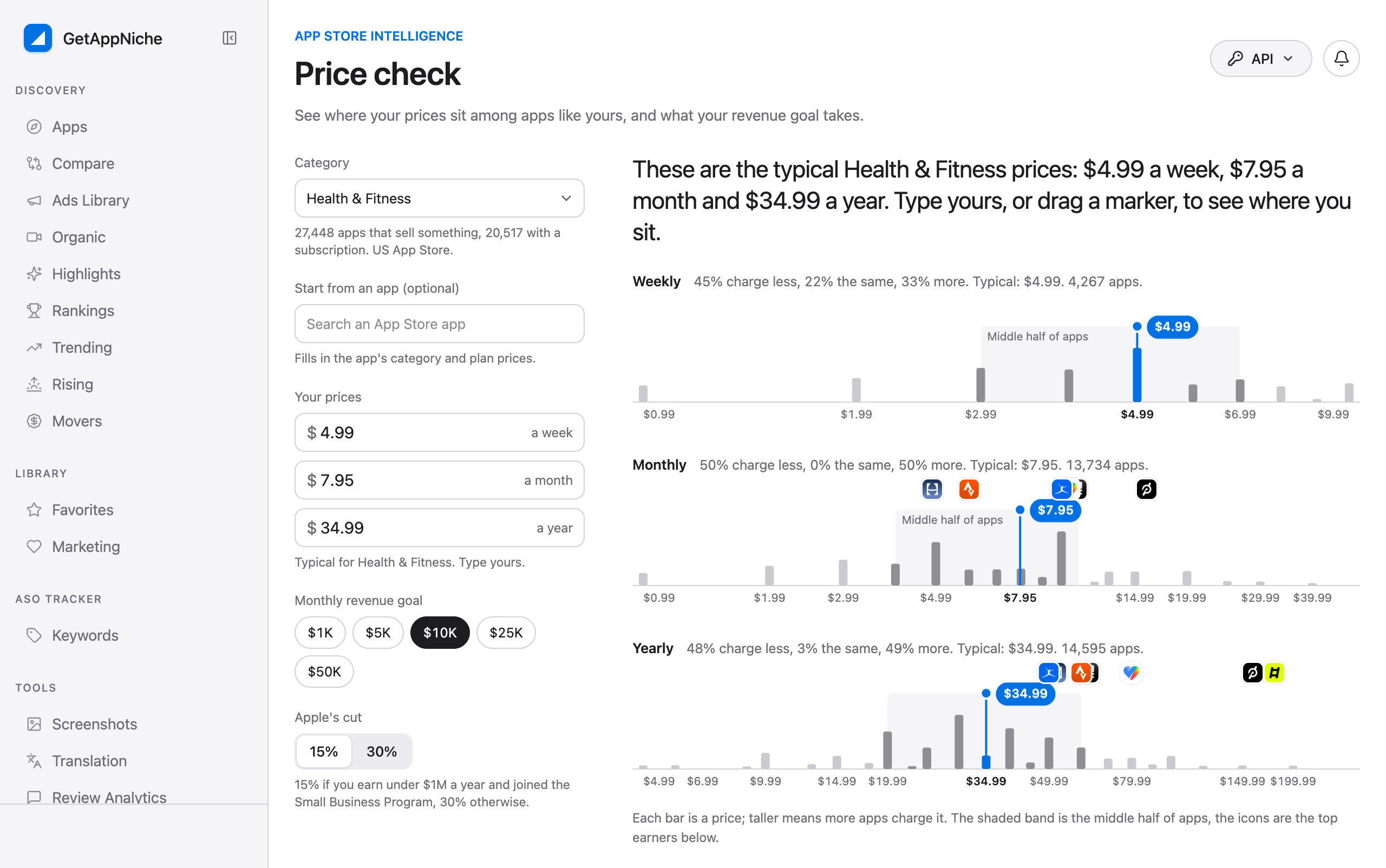
- Then check where you sit. A typical price is the middle of the market. Whether yours is in the cheap third or next to the top earners is what Price check shows in the app.
The rules behind the 15% and 30% rates are in App Store commission fees explained. Which way of charging earns the most in each category is in which app pricing model makes money, and what a download is worth in app revenue per download.
Price check in the app: where your price sits among apps like yours
The calculator above is the math. Price check adds the market: each plan length drawn as a ruler of what the category's apps charge, with your price and the top earners marked on it.
What the calculator can't tell you
- Cancellations. The subscriber figure is how many must be paying at the same time. People cancel, so staying there takes more sign-ups than the figure shows.
- Free trials and intro offers. Every subscriber is counted at the full price from the first day.
- Your conversion rate. The 2% it opens with is a starting assumption you can move from 0.5% to 10%, not a benchmark for your app.
- Two rates at once. Apple's cut on a subscription drops to 15% after a subscriber's first year even outside the Small Business Program. The calculator applies one rate to everyone.
- Taxes, refunds and other countries. Sales tax and VAT, refunds and local prices are left out. The typical prices are US App Store prices in US dollars.
- Whether your price is right. The calculator shows what a price takes to reach a goal. Where it sits among the apps of your category, and what the top earners charge, is in the app.
App pricing: questions and answers
How much should I charge for my app?
Start from what apps in your category already charge. On the US App Store the typical subscription costs $4.99 a week, $5.99 a month or $29.99 a year (GetAppNiche data, US App Store, Nov 2, 2026), and categories differ: Health & Fitness apps typically charge $7.99 a month. Then check that the price can reach your revenue goal with a number of downloads you can realistically get.
How many subscribers do I need to make $10,000 a month?
At the typical $5.99 a month you keep $5.09 per subscriber after Apple's 15% cut, so $10,000 a month takes 1,965 paying subscribers. At Apple's 30% rate you keep $4.19 and need 2,387. If 2% of downloads become subscribers, that is 98,300 to 119,400 downloads.
How much does Apple take from an app's price?
Apple's standard commission is 30%. It drops to 15% for members of the App Store Small Business Program (up to $1 million in proceeds the previous year) and for subscriptions after a subscriber's first year of paid service.
Should a yearly plan cost ten times the monthly price?
Most apps discount more than that. Among the 77,437 US App Store apps that sell both, the yearly plan costs about 6 months of the monthly price at the median (GetAppNiche data, US App Store, Nov 2, 2026). The typical yearly plan is $29.99.
Is a weekly subscription worth offering?
Per month it brings in more: the typical weekly plan is $4.99, which adds up to $21.62 a month against $5.99 for the typical monthly plan. The calculator counts a subscriber as long as they keep paying; it does not model how quickly weekly subscribers cancel.
What is a typical in-app purchase price?
The median cheapest purchase an app sells on the US App Store is $2.99; half of the apps that sell something start between $1.99 and $5.99 (285,304 apps, GetAppNiche data, US App Store, Nov 2, 2026).
What conversion rate should I use?
Your own, if you have one. The calculator starts at 2% of downloads becoming paying subscribers and lets you set anything from 0.5% to 10%. It is an assumption for the math, not a benchmark.
Is the app pricing calculator free?
Yes. The calculator runs in your browser and needs no account. Price check in GetAppNiche adds where your price sits among the apps of your category, what the category's top earners charge, how many apps reach your goal and suggested prices for other countries; it is part of Pro, from $39/month.
Related: in-app purchases explained · how much an app makes · app ideas that make money · compare apps side by side · GetAppNiche pricing